Benign prostatic hyperplasia, more commonly known as BPH, is an enlargement of the prostate gland. It frequently occurs as men age and can contribute to bothersome lower urinary tract symptoms (LUTS). BPH is very common. In fact, it is one of the leading reasons men visit a urologist.
The prostate gland grows throughout a man’s adult life and, as it enlarges, it can compress the urethra (urine tube) making it more difficult to urinate.
This compression of the urethra can cause bothersome urinary symptoms and, if left untreated, potential damage to the bladder muscle. BPH is not cancer; patients can have BPH and prostate cancer at the same time.
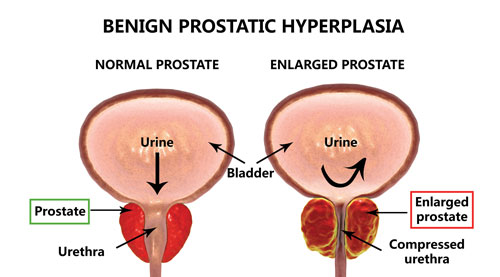
The prostate is part of the male reproductive system. It is about the size and shape of a walnut and weighs about an ounce. This gland is found below the bladder and in front of the rectum. It goes all the way around the urethra, which carries urine from the bladder out through the penis.
The prostate produces a fluid that makes up a portion of semen volume and protects sperm.
If you have issues with urination, please call UroPartners at (630) UROLOGY to schedule a consultation with one of our physicians in the Chicago area.
Scheduling an appointment online is quick and easy.
In this section:
While BPH is a benign condition, the bothersome urinary symptoms associated with BPH can greatly affect your quality of life.
We are ready to help!
Are you experiencing one or more of the following symptoms?
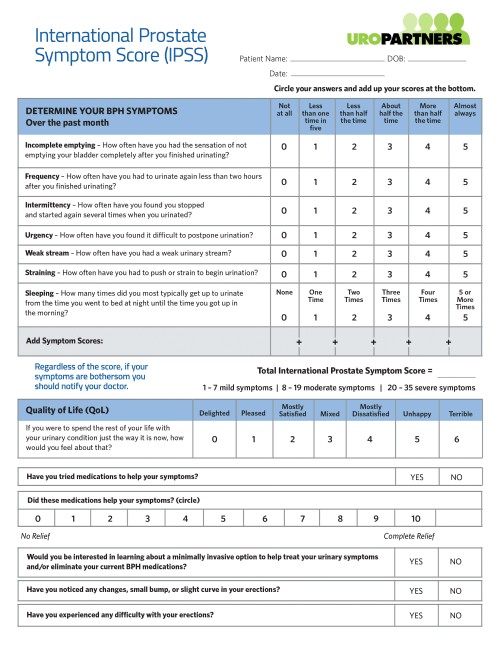
These symptoms are called lower urinary tract symptoms, or LUTS, and can be easily assessed with a simple questionnaire called the International Prostate Symptom Score (IPSS). You complete this questionnaire at the time of your visit and it takes just five minutes to identify the severity of your bothersome urinary symptoms.
Up to 90% of men over the age of 80 have BPH
Call your urologist immediately if you have:
These symptoms could indicate a more serious condition that requires immediate medical attention.
If you have issues with urination, please call UroPartners at (630) UROLOGY to schedule a consultation with one of our physicians in the Chicago area.
Scheduling an appointment online is quick and easy.
In this section:

Download our patient guide.

If BPH is suspected, simple tests performed during your initial evaluation will help your doctor diagnose the severity of your bothersome urinary symptoms and put you on a pathway to wellness. Tests will vary from patient to patient, but the most common tests include:
Additional diagnostic studies may be performed to evaluate your bladder health and disease progression.
UroPartners provides expert care in BPH. Our board-certified urologists will take the time to work with you to customize a treatment plan that
meets your expectations and improves your quality of life.
You don’t have to live with BPH.
Earlier interventional treatments that address the obstruction may help preserve bladder health and improve your quality of life. You will undergo simple baseline tests to determine the severity of your symptoms and help you understand your options to develop your BPH Care Plan.
Potential risks associated with untreated BPH could include bladder retention (inability to urinate) and irreversible bladder damage. Changes to the bladder due to an enlarged prostate can lead to the need for a permanent bladder catheter.
If you have issues with urination, please call UroPartners at (630) UROLOGY to schedule a consultation with one of our physicians in the Chicago area.
Scheduling an appointment online is quick and easy.
In this section:
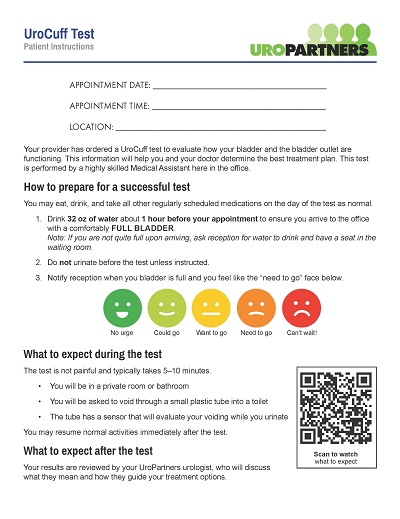
The UroCuff Test provides your urologist with information about your bladder function to better understand the causes of your symptoms. The UroCuff is a non-invasive diagnostic test for male urinary disorders (LUTS). This test allows your urologist to collect important data about your bladder function while you urinate and can provide better answers about your symptoms. You will be reassessed periodically to measure changes in bladder function and the effectiveness of your treatment plan.
A cystoscopy is a diagnostic prostate exam performed by your urologist in their office to determine the cause of your symptoms and the best treatment options. This brief procedure typically takes about 5 minutes. Cystoscopy enables your urologist to view your anatomy to assess bladder health, confirm the diagnosis of an enlarged prostate, assess which BPH procedure may be most appropriate for you, and rule out other bladder conditions.
A prostate ultrasound is a quick and very precise method to determine prostate volume measurement, which is important in choosing the correct procedure.

Medications designed to relax the smooth muscle in the prostate and bladder neck to allow urine to flow better. Common side effects can include: dizziness, fainting, headaches, lightheadedness and low blood pressure. They may also lead to retrograde ejaculation. This is when sperm go backwards into your bladder instead of out through your penis during orgasm. It is not harmful, but it means you will ejaculate very little or no semen.
Medications designed to shrink the size of the prostate. These can take up to 6 months for maximum effect and may be prescribed in conjunction with an alpha blocker. Common side effects can include: erectile dysfunction, lower sex drive and retrograde ejaculation.
The UroLift System is a minimally invasive procedure to treat an enlarged prostate. It is a proven option for patients looking for an alternative to medications or major surgery. It is a procedural approach to treating an enlarged prostate that does not require any cutting, heating or destruction of the prostate tissue with preservation of sexual function.
The UroLift System uses a revolutionary approach to treating BPH that lifts and holds the enlarged prostate tissue so it no longer blocks the urethra. The UroLift System has been proven safe and effective and provides rapid relief of your troublesome urinary symptoms.
Rezum Water Vapor Therapy is a non-surgical treatment that uses the natural energy stored in water vapor, or steam, to remove excess prostate tissue that is pressing on the urethra. During each 9-second treatment, sterile water vapor is released throughout the targeted prostate tissue. Your doctor will determine the number of treatments you need based on the size of your prostate. Over time, your body’s natural healing response absorbs the treated tissue, shrinking the prostate.
There are also several outpatient surgical options used for the treatment of BPH that are all performed endoscopically, with no incisions and minimal blood loss. During all these procedures, a scope is placed into the urethra, the prostate is visualized directly, and the enlarged prostate tissue is treated to open the channel.
One of these procedures is a photoselective vaporization of the prostate, also known as the GreenLight Laser Therapy. Our board-certified urologists have extensive experience with GreenLight laser vaporization of the prostate, which is a minimally invasive option for patients with larger prostates.
Learn more about Greenlight Laser Therapy.
Optilume BPH is a drug-coated balloon inserted into the urethra to the prostate via a telescopic camera. The balloon expands and creates an opening to release the safe and proven drug, paclitaxel, into the prostate.
When the drug is fully released, the balloon is deflated and removed. The applied drug prevents re-fusion of the lobes during healing, keeping the prostate open, restoring the flow of urine, and relieving symptoms.
Another procedure in this manner is a bipolar transurethral resection of the prostate, or TURP, in which bipolar energy is used to resect overgrown prostate tissue. Again, our board-certified urologists have years of success with this treatment.
UroPartner’s new Interventional Radiology (IR) Centers offer Prostate Artery Embolization (PAE). PAE is a recommended treatment for men suffering from an enlarged prostate who are not candidates for traditional surgical options.
PAE is a minimally invasive procedure in which the interventional radiologist guides a microcatheter into the blood vessels supplying the prostate. Microscopic beads are injected into the blood vessels feeding the prostate, blocking blood flow to the prostate gland. This causes the prostate to shrink, soften, and absorb over time. This procedure requires no surgical incision and no insertion of a device into the urethra.
Aquablation therapy is a resective procedure, meaning that the prostate tissue causing symptoms is removed. No
incision is made, as the prostate is reached through the urethra. It can be performed on prostates of any size and shape and is the only procedure that combines a camera (called a cystoscope) with ultrasound imaging, giving the surgeon the ability to see the entire prostate in real-time.
Simple prostate removal, or prostatectomy, is a procedure to remove the inside part of the prostate gland to treat an enlarged prostate. It is done through a surgical incision and generally requires a 2-4 day hospital stay, 6-8 weeks recovery.
Learn more about protatectomy.
This is enucleation (keeping the capsule intact) of the prostate. It is done through a single incision approximately 1 ½ inches long below the belt line and accessing the prostate directly through the bladder. This is a safer technique with less pain postoperatively due to not having to use more than one incision and not going through the abdominal cavity. The entire procedure usually takes around 90 minutes plus time for anesthesia. Patients are sent home the same day with a Foley catheter for 10-14 days. This is the only procedure that can remove 90% or more of the prostatic tissue blocking the bladder for prostate glands larger than 120cc in volume.
Learn more about protatectomy.
If you have issues with urination, please call UroPartners at (630) UROLOGY to schedule a consultation with one of our physicians in the Chicago area.
Scheduling an appointment online is quick and easy.
In this section: